Agent Company OS
Agent Company OS is a multi-agent operating model: scoped workspace brain, memory/skill overlay, runtime command plane, department lead agents, specialized workers, and a proof loop that writes work back into memory.
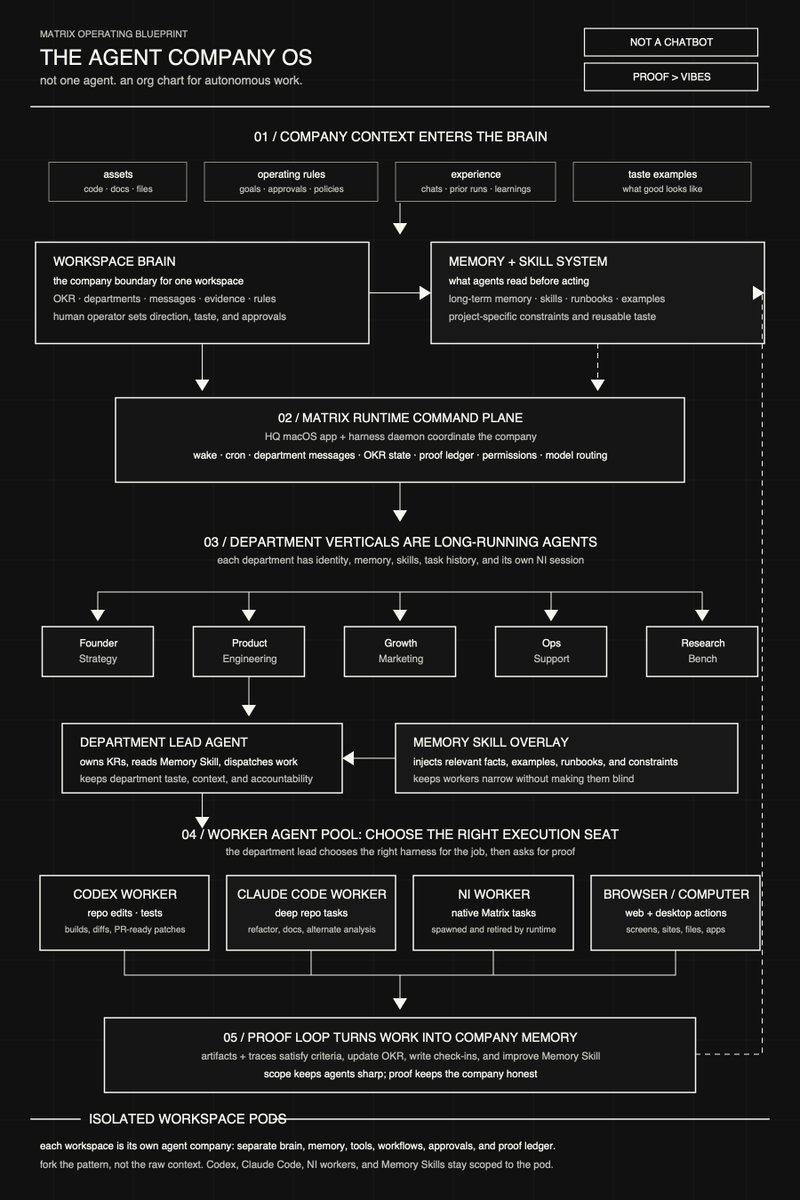
Derek Nee's "Matrix Operating Blueprint" is a concise architecture diagram for autonomous work. The core claim is that company-scale agent work cannot run through one giant omniscient agent. The system needs boundaries, operating rules, accountable leads, scoped workers, and proof artifacts. Source: X/@DerekNee, 2026-06-25
Architecture
The diagram has five load-bearing layers:
| Layer | Job |
|---|---|
| Company context | Source material enters as assets, rules, past experience, and examples of taste. |
| Workspace brain | Holds the boundary for one workspace: objectives, departments, messages, evidence, and rules. |
| Memory + skill system | Stores what agents read before acting: long-term memory, skills, runbooks, examples, project constraints, and reusable taste. |
| Runtime command plane | Coordinates wakeups, cron, messages, objective state, proof ledger, permissions, and model/runtime routing. |
| Department agents and workers | Long-running department leads own accountability, then dispatch work to the right execution seat: Codex, Claude Code, native workers, or browser/computer workers. |
The final layer is the proof loop. Artifacts and traces satisfy criteria, update objective state, write check-ins, and improve the memory/skill system. Source: X/@DerekNee image, 2026-06-25
Design Implications For Kevin's Wiki
This pattern maps directly onto Kevin's existing operating system:
wiki/SOUL.md,wiki/USER.md,wiki/HEARTBEAT.md, and Agent Operations Hub are the workspace brain boot path.skills/personal/**/SKILL.md, Skill Resolver, Active Stack (What to Actually Use), and Capability Routing Map are the memory/skill overlay.scripts/check-freshness.ts,automations/,state.json, and Codex/Cursor/Claude harnesses are the command-plane layer.- Task-specific skills act like department leads: Cloud, Data, and Service Skills for source compile, Browser Testing Skills for skill work, Security and Review Skills for strict review, and design-engineering-polish / Frontend and Design Skills for design work.
wiki/log.md,_absorb_log.json, doctor outputs, qmd rebuilds, screenshots, and test output are the proof ledger.
The operational upgrade is to keep agents narrow without making them blind. A worker should get the relevant memory skill overlay, not the whole wiki or every tool. A lead agent should own routing, approvals, and proof, not every low-level action.
Greg Isenberg's 2026 diagrams add the operator-facing version: humans move to strategy, taste, and judgment while agents execute bounded loops. That does not remove the command plane; it makes the command plane more important because each agent's goal, metric, proof, and escalation path must be explicit. Source: X/@gregisenberg, 2026-06-27
Giga Scout is the hosted-product version of the same control problem. Its public model starts from a business KPI, learns from real customer conversations, files fixes as policy/tooling/knowledge changes, tests safe changes on traffic slices, and escalates risky changes to humans. That makes the metric and rollout policy first-class parts of the agent company OS rather than after-the-fact reporting. Source: Giga Scout, 2026-07-02
Greg's four reviewed diagrams add an operator-facing checklist for deciding where the architecture applies:
- Org chart: humans own strategy, taste, judgment, and trust; support, sales, research, finance, ops, and legal agents execute against shared customer data, SOPs, pricing, permissions, brand voice, and decision logs.
- AI-native stack: clean data -> structured knowledge -> permissions/policies -> agent workflows -> human review -> continuous learning. The leverage comes from making the business readable, not from buying an agent tool.
- Opportunity map: prioritize work that is repetitive enough for agents and complex enough that incumbents are slow. Insurance ops, recruiting, compliance, support, healthcare admin, and legal intake sit in the high-value quadrant.
- Workflow compression: replace human maze steps like inbox, search, Slack question, document hunt, and approval with agent context, policy check, draft/action, human approval, response, and learning loop.
This keeps the architecture grounded: an agent company is not "agents everywhere." It is a workflow-selection discipline plus a context/policy/proof stack. Source: X/@gregisenberg, 2026-06-27; Source: local artifact review, 2026-07-03
Workspace Pod Rule
Each workspace should be its own pod: separate brain, memory, tools, workflows, approvals, and proof ledger. Fork the pattern, not raw context. This supports Kevin's existing kevin-wiki, Dedalus, Agent Machines, Loop, and project-specific agent-docs meshes: each project can share the same operating model while keeping local constraints and evidence scoped.
Anti-Patterns
- One agent with every file, every tool, and no accountable boundary.
- A command room with no proof ledger.
- Workers that can spawn more workers without recorded objective, budget, or cancellation state.
- Memory that only accumulates context and never updates skills, rules, or runbooks.
- Department-like pages or skills that nobody routes through.
Timeline
- 2026-07-03 | Deep-reviewed Greg Isenberg's four local diagrams and added the operator checklist: humans own judgment, shared context is the real stack, opportunities need repetition plus complexity, and maze-like workflows compress into policy-gated agent loops. Source: X/@gregisenberg, 2026-06-27; Source: local artifact review, 2026-07-03
- 2026-07-02 | Added Giga Scout as a concrete KPI-governed agent-company product example: define the metric, learn from conversations, file fixes, test on slices, escalate risky changes, and write accepted changes back into policy or knowledge. Source: Giga Scout, 2026-07-02
- 2026-06-29 | Added Greg Isenberg's operator-facing agent-company diagrams: humans move to strategy/taste/judgment while agents execute bounded loops, making goal, proof, metric, and escalation state load-bearing. Source: X/@gregisenberg, 2026-06-27
- 2026-06-25 | Page created from Derek Nee's Agent Company OS blueprint and mapped into Kevin's wiki/skills/automation architecture. Source: X/@DerekNee, 2026-06-25